Running on Instinct and a Bank Balance
There is a moment nearly every founder I work with can describe precisely.
Revenue is growing. The team is expanding. Clients are coming in. On paper, everything looks like progress.
And yet something feels wrong.
Cash is tighter than it should be. The monthly numbers arrive late, or in a format that answers nothing. Decisions that used to feel confident now feel like guesses. The founder is running on instinct and a bank balance, hoping the gap between the two never becomes a crisis.
That moment has a name. I call it the financial infrastructure wall. It is the single most common, most damaging and most avoidable problem I see in founder-led businesses between £1 million and £10 million in revenue.
The gap nobody warned you about
In the early days, keeping the books tidy and filing the returns on time is enough. The founder holds the numbers in their head. Decisions get made quickly because the business is simple enough to understand intuitively.
Then something changes.
A second location. A new service line. A headcount that tips past thirty. The business gets more complex, but the finance function stays exactly where it was: covering compliance, covering the basics, and nothing more.
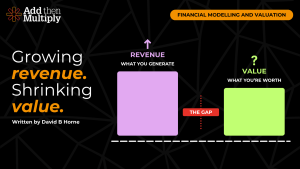
This is the gap. Not a dramatic collapse. Just a quiet, persistent lag between the complexity of the business and the financial intelligence available to run it.
Bookkeeping is still handled. But there is no rolling cash forecast, no margin clarity by product or customer, and no reporting that a board, lender or investor would take seriously.
At £1 million, that is a manageable risk. At £5 million, it is a constraint. At £8 million, it is a crisis in slow motion.

Want to full framework behind building a scalable business?
The Add Then Multiply eBook covers every stage: funding, acquisition, consolidation and exit, with real examples from businesses that have done it.
Does any of this sound familiar?
The gap shows up differently depending on your business, but the underlying problem is identical.
In clinical and healthcare businesses, it is invisible cost per patient. The appointment book is full, but nobody can say which services are genuinely profitable, or whether a second site is performing as well as the first. A near-miss with payroll or a badly timed VAT bill sends a jolt through leadership.
In agency and creator-led businesses, it is multiple revenue streams with no clear picture of which ones are worth running. The data is messy. Cash is lumpy despite strong top-line numbers. Tax surprises land without warning.
In technology businesses, it is the investor meeting that could have changed everything. The product is strong, the opportunity is real, but when due diligence begins the numbers do not yet tell the story the founder knows to be true.
The sectors are different. The pattern is identical.
Compliance finance versus strategic finance.
Most businesses at this stage have finance covered in one sense. The books are done. The returns are filed.
But compliance finance is backward-looking. It tells you what happened last quarter. It does not tell you what is about to happen next month, whether the business can afford the hire on the table, or whether the cash will hold long enough to support the growth plan you are committed to.
Strategic finance uses financial data to drive decisions, not simply record them. In practice: a rolling 13-week cash forecast the founder actually trusts. A month-end pack delivered within ten working days, decision-ready rather than just compliant. Margin clarity across products, services and customer segments. And a confidential conversation about money every week with someone experienced enough to challenge your thinking.
The businesses that break through £10 million have all made this shift. Finance stops being the department that files the paperwork and starts being the function that drives the strategy.

How does your financial infrastructure measure up?
Take our free Growth Readiness Assessment and find out exactly where your business stands across leadership, operations, finance and growth readiness.
Five signs your finance function is not keeping pace
The founder is still the financial decision-maker of last resort. Every significant expenditure runs through you because nobody else has the visibility. Your time is consumed by operational finance when it should be directed at growth.
Month-end reporting is late or incomprehensible. The numbers arrive weeks after the period closes in a format that raises more questions than it answers.
Cash flow is managed reactively. No rolling forecast. Frequent surprises. Payroll and VAT managed week to week rather than planned quarter to quarter.
No clarity on margin by product, service or customer. Revenue is growing but profitability is flat or declining. Pricing decisions are still made on instinct rather than data.
The business could not produce investor-grade financials at short notice. If an acquirer or lender asked for a clean data room tomorrow, it would take weeks to build one.
If three or more of these are true, your financial infrastructure is already behind where it needs to be.
What changes, and what comes next?
Within 90 days of committing to this shift, a business should have a trusted 13-week cash model, a month-end pack delivered by the tenth working day, margin clarity across products and geographies, and at least one measurable improvement in pricing, collections or spend discipline already in motion.
Most importantly, the founder sleeps at night.
This matters beyond the day-to-day. Funding, acquisition and exit all depend on the financial infrastructure being in place before the opportunity arrives. The FACE methodology, Fund, Acquire, Consolidate, Exit, only works if the financial foundations are solid. A business with clean, investor-grade financials commands a premium at every stage. A business without them takes a discount.
So let me ask you directly: if an investor or acquirer asked to see your financials tomorrow, would you be ready?
If the honest answer is no, that is the most important problem in your business right now.
David B Horne

Founder of Add Then Multiply & Funding Focus
Add Then Multiply is a fractional finance and business scaling consultancy helping founder-led businesses at £1M–£10M+ to Fund, Acquire, Consolidate, and Exit.