Most founders measure progress in revenue.
This year was bigger than last year. The top line climbed. New clients came in. The team grew. By every measure they were told to care about, the business is moving in the right direction.
And yet something feels off.
The cash position isn’t where it should be. The margins are harder to hold than they were at half the size. The business is more complex, more demanding, and somehow more fragile, not less.
After forty years in finance and thirty-odd M&A transactions, I’ve seen this pattern more times than I can count. And the founders who feel it most acutely are almost always doing one thing.
They are confusing revenue growth with value creation.
They are not the same thing. And the gap between them is where most founder-led businesses quietly stall.
Three founders. Three versions of the same confusion.
The founder with strong revenue and a growing team. Turnover is up. Cash is still tight. Margins are thinner than they were at smaller scale. They’ve been building revenue. They haven’t been building value.
The founder with multiple income streams and genuine brand recognition. Every new product or service adds to the top line. But the business is getting harder to run, not easier. Margins on some streams are strong. Others are quietly diluting the whole. They’ve been adding. They haven’t been multiplying.
The founder with real traction and investor interest who sits down with a funder and discovers the business can’t be valued the way they imagined. The revenue is there. The recurring element is unclear. The churn is high. The unit economics don’t hold under scrutiny. The investor sees a revenue line. They don’t see a business.
Three very different situations. The same underlying problem.
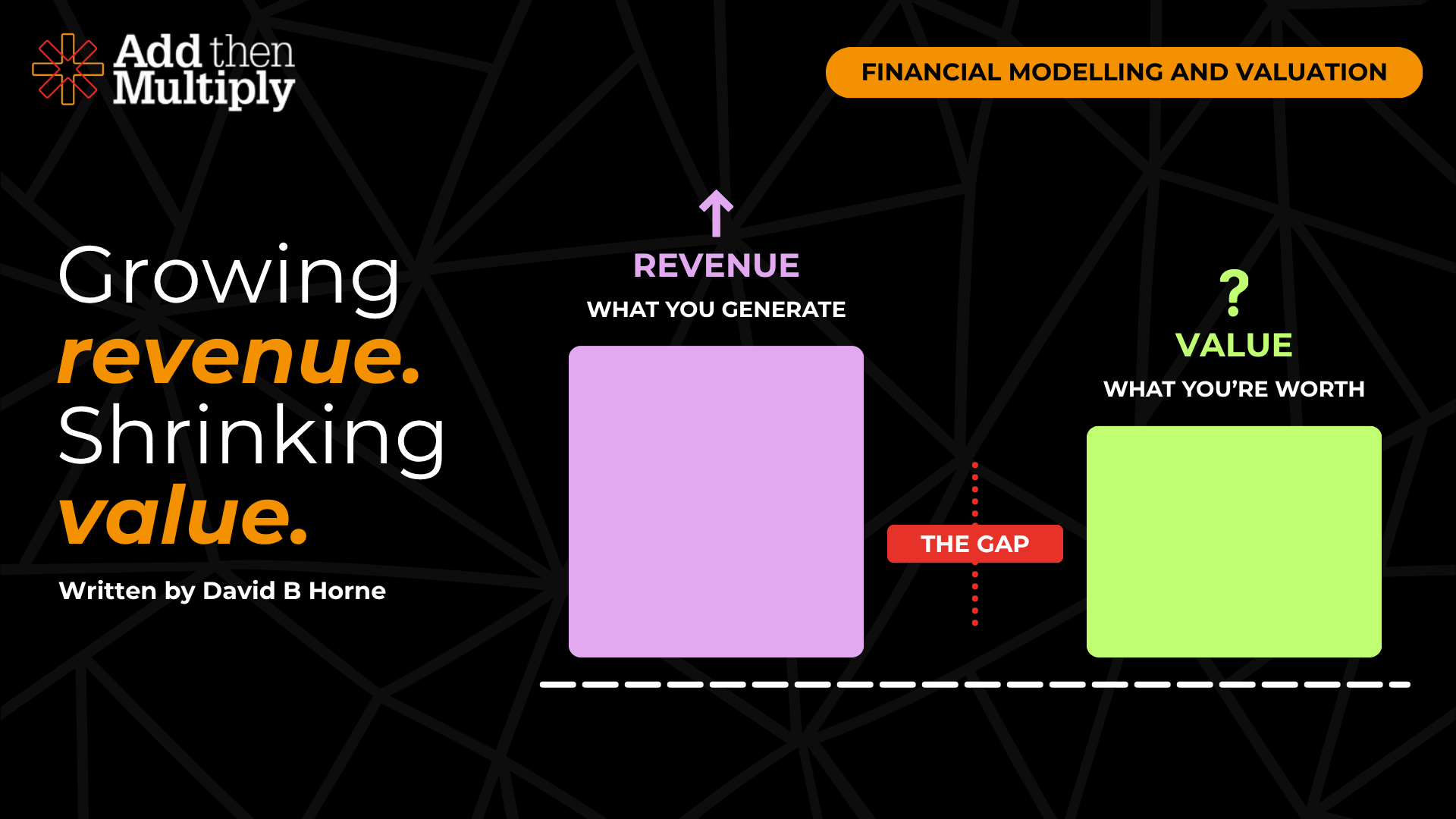
Revenue is what the business generates. Value is what the business is worth. And growing one does not automatically grow the other.

Add Then Multiply has a full chapter on what actually drives business valuation.
Get your free copy for the real deals, the real numbers, and what closing the gap between revenue and value looks like in practice.
What actually drives value in a founder-led business
I’ve been on both sides of the valuation table.
And what buyers, investors, and lenders actually look for is almost never what founders expect.
They are not looking for the biggest revenue number. They are looking for the most predictable, defensible, and scalable earnings. They want to know that the revenue will still be there after you leave. That the margins hold under pressure. That the business has a model, not just a history.
The businesses that attract the strongest valuations are the ones where:
Revenue is recurring or highly repeatable, not lumpy and relationship-dependent.
Gross margin is strong, understood, and improving, not eroding as the business scales.
The business operates without the founder being in every room, so the value doesn’t walk out the door with them.
The financial reporting is clean enough to show all of the above clearly, quickly, and credibly.
Most founder-led businesses between £1m and £10m score well on one or two of those. Rarely all four.
The moment most founders realise the gap
The gap between revenue and value usually becomes visible at one of three moments.
The first is a funding conversation. The investor asks a question the founder can’t answer cleanly, and the terms offered reflect that uncertainty.
The second is an acquisition process. Due diligence reveals that the business is more dependent on the founder, or less profitable, or more complex to integrate than anyone had assumed. The headline price drops.
The third, and most avoidable, is a strategic review where the founder finally asks: if I wanted to sell this business in three years, what would it actually be worth today? And the answer is uncomfortable.
Every one of those moments is fixable. But the earlier you understand the gap, the more time you have to close it.

Not sure what your business is actually worth to a funder, lender, or acquirer?
The Funding-Ready Scorecard tells you exactly where you stand before they do, in under a minute.
What closing the gap actually looks like
Closing the gap between revenue and value is not a single conversation. It is a programme of work.
It starts with understanding your unit economics clearly enough to know which parts of the business create value and which consume it. It continues with building the financial model that shows not just what the business earns but what it is worth and what it could be worth with the right moves. It requires reducing founder dependency until the business can demonstrate it runs without you. And it demands the kind of financial reporting that makes all of that visible, to you first, and then to whoever sits across the table.
That is the work Add Then Multiply does with founder-led businesses every day. Not just building the foundations. Building the business that is worth what it deserves to be worth.
Know your numbers. Build your foundations. Then add. Then multiply.
What’s the gap between your revenue and what you think the business is actually worth?
Before you go
📖 Get your copy of Add Then Multiply, and explore a full chapter on financial modelling and what drives business valuation in practice.
⚡ With our Funding Scorecard, find out exactly where you stand before a funder, lender, or acquirer does it for you.
✉️ Our weekly newsletter, The Multiplier Effect lands every Wednesday. Practical thinking on funding, scaling, and building a business worth owning.
David B Horne

Founder of Add Then Multiply & Funding Focus
Add Then Multiply is a fractional finance and business scaling consultancy helping founder-led businesses at £1M–£10M+ to Fund, Acquire, Consolidate, and Exit.