There’s is a BIG difference between the two.
Most founders do not realise it until the cost of confusing the two has already arrived.
Growing means the business is becoming more valuable, more resilient, and more capable of running without the founder holding it all together.
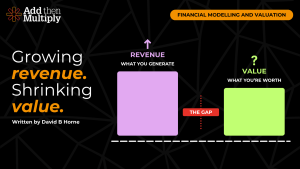
Getting bigger means revenue is up, the team has expanded, and the complexity has quietly multiplied. But the foundations underneath have not kept pace.
I have worked with founders at every stage from £1 million to £10 million and beyond. The products are different. The sectors are different. The pain underneath is almost always the same.
The business has outgrown the infrastructure it was built on. And nobody is talking about it clearly enough.
The moment it stops feeling like progress
In the early days, growth feels clean. Revenue goes up. The team expands. Decisions get made quickly because the founder has everything in their head.
Then something shifts.
The numbers arrive late, or in a format that answers nothing. Cash is tighter than it should be given the revenue on the books. The founder is still the person every significant decision runs through, even though the business is now far too complex for one person to hold.
Momentum starts to feel like pressure.
This is not a failure of ambition. It is a structural gap. And it shows up differently depending on the business you have built.

📖 Looking to build a business that scales without breaking?
The Add Then Multiply book is the complete playbook for founder-led growth: Fund, Acquire, Consolidate, Exit. Real examples, practical frameworks, and every stage of the journey covered.
Get yours now in either an eBook version or physical copy.
When the diary is full but the numbers do not add up
You built this business because you are exceptional at what you do. Clients come. The team grows. A second site, or even a third, is either already open or being planned.
But here is the question keeping you up at night. Which parts of what you deliver are actually profitable? Not just busy. Profitable.
The appointment book does not tell you that. Neither does the monthly report that arrives two weeks after the period closes in a format no board or lender would take seriously.
A near-miss with payroll. A tax bill that landed without warning. A cash position that looked fine on Monday and felt frightening by Friday.
You went into this to scale your impact. Instead, you are the financial decision-maker of last resort in a business that has grown faster than the systems holding it together.
The question is not whether you need better financial infrastructure. The question is how long you can afford to wait for it.
When top-line growth is hiding the real picture
You have built something distinctive. A brand people recognise, an audience that trusts you, revenue streams that span products, services, and communities.
On paper, the numbers look strong. In practice, cash is lumpy, data is messy, and you have no clear view of which parts of the business are worth scaling and which are quietly consuming margin you cannot afford to lose.
Tax surprises land without warning. Pricing decisions still get made on instinct rather than data. And the thought of bringing in a lender, investor, or acquisition partner right now is exciting in theory and uncomfortable in practice, because the numbers do not yet tell the story you know to be true.
You have not built this to stay at this size. The ambition is real. But ambition without financial clarity is not a growth plan. It is a guess.
⚡Are you funding ready, or are you assuming you are?
Most founders find out the hard way. Our Funding-Ready Scorecard shows you exactly where your business stands across financial foundations, growth traction, and investor readiness, before a funder, lender, or acquirer does it for you.
Try it now, it takes less than a minute.
When the product is ready but the financials are not
The product is strong. Investor interest is present. The opportunity in front of you is genuinely significant.
And yet the conversation you need to have, with a serious investor, a strategic partner, or an enterprise client demanding tighter governance, keeps getting delayed. Not because the business is not ready. Because the reporting is not.
The numbers are not investor-grade. And every week that passes without fixing that is a week where dilution on weak terms becomes more likely, not less.
You know what the business is worth. The challenge is building the financial credibility to prove it to the people who need to see it before they will back you at the terms you deserve.
Reputation matters to you. So do the terms. Both depend on getting the foundations right before the next conversation begins.
What every one of these has in common
Different businesses. Different pressures. Different fears.
But the same underlying problem.
The business has grown into territory that the current financial and operational infrastructure was never designed to support. And without the right foundations, every next decision, whether that is a new hire, a second site, a funding round, or an acquisition, carries more risk than it should.
The founders who break through to the next level are not braver or luckier than the ones who stall.
They simply made a decision, at the right moment, to find out exactly where they stood before the next move. And then they built from there.
Three questions worth sitting with
- Do you know your margin by product, service, or customer?
- Or is top-line revenue still the number you trust most because it is the one you can actually see?
- If an investor, lender, or acquirer asked for your financials tomorrow, how long would it take you to produce something you would be proud to put in front of them?
And honestly: is your business less dependent on you than it was twelve months ago? Or has growth made it more dependent, not less?
The answers matter. Not because they are uncomfortable, but because they tell you exactly where to start.
David B Horne

Founder of Add Then Multiply & Funding Focus
Add Then Multiply is a fractional finance and business scaling consultancy helping founder-led businesses at £1M–£10M+ to Fund, Acquire, Consolidate, and Exit.