In the autumn of 2008, we made an announcement to the stock exchange.
The integration was complete. Everything was on track. The business was performing as expected. The perspective we had given investors at the time of the acquisition was holding.
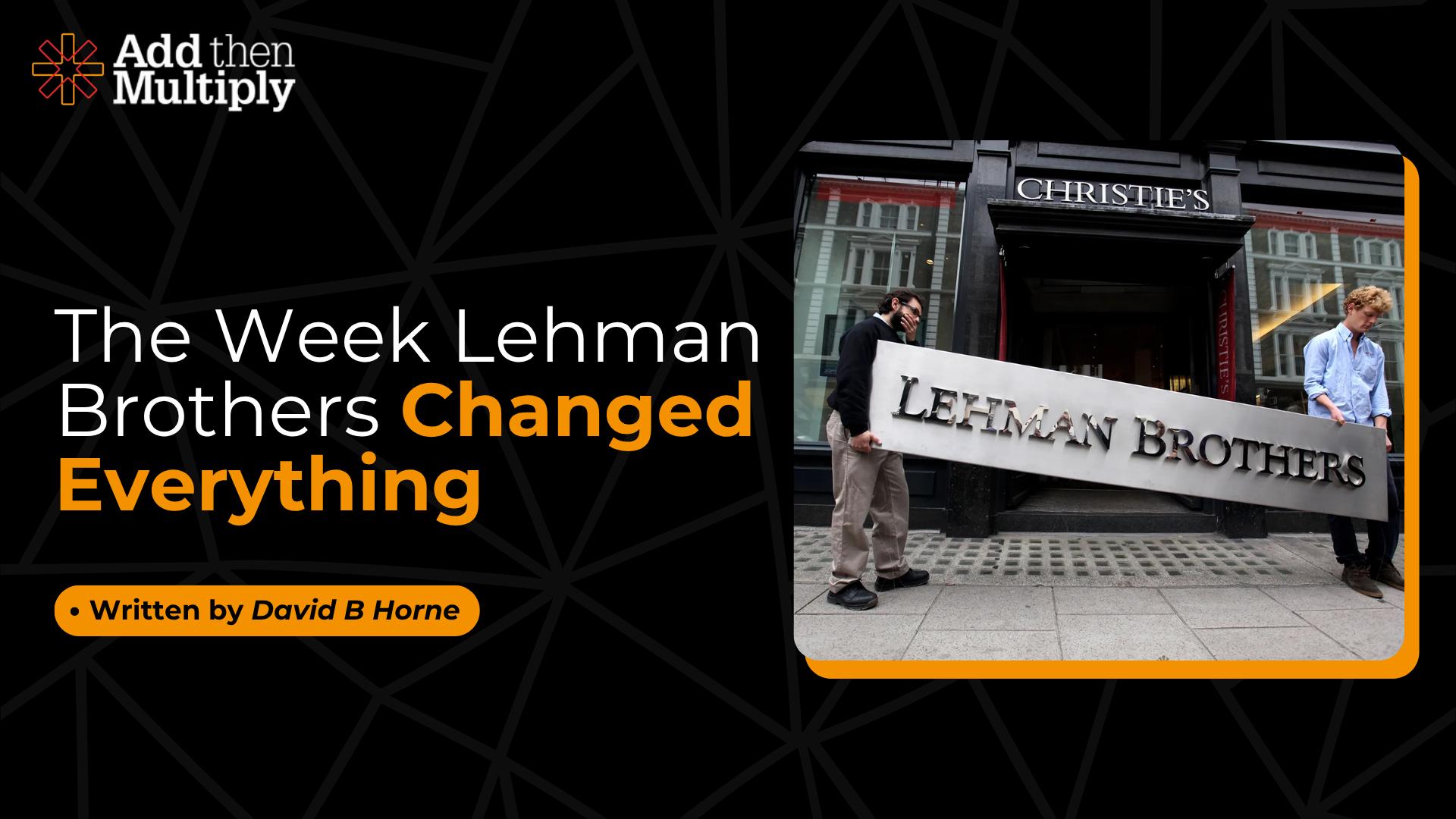
A week later, Lehman Brothers filed for bankruptcy.
And in the fourth quarter of that year, six million pounds of expected revenue did not materialise. It fell straight to the bottom line.
What followed was one of the most brutal and instructive periods of my career. Four profit warnings in six months. The chief executive departing. A rescue rights issue to ensure the business had the cash to survive. Negotiations with lenders that required every piece of financial information we had to be clear, current, and credible.
And I remember thinking, in the middle of all of it, that the businesses coming through that period intact were not the ones with the best products or the strongest pipelines.
They were the ones that could see what was happening in real time. The ones with the financial infrastructure to know exactly where they stood, week by week, and the technology to act on that information before the window closed.
We survived. But I carried the lesson from that period into everything I built afterwards.
What the crash revealed
The businesses that struggled most in the aftermath of 2008 were not always the most exposed ones.
They were often the ones with the least visibility.
The ones where the financial reporting was a month behind reality. Where the management information was a best estimate rather than a live picture. Where the leadership team was making decisions based on information that was already out of date by the time it arrived.
When the world changes in a week, a month-old P&L is not a management tool. It is a historical document.
The businesses that navigated that period most effectively, the ones that made faster decisions, renegotiated facilities before the pressure became existential, and came out the other side with the confidence of their investors and lenders intact, were the ones that had invested in the right financial and operational technology before they needed it.
Not because they saw Lehman Brothers coming. Nobody did.
Because they had built their businesses for the unexpected. For the moment when the world shifts faster than anyone anticipated and the only question that matters is: do you know exactly where you stand right now?

The 2008 crash is one of many stories in Add Then Multiply.
The book covers the full Technology and Innovation chapter, with real examples from thirty-odd deals of what the right internal infrastructure looks like in practice, and what it costs when it isn’t there.
The technology most founders underestimate
When I talk to founders about technology and innovation, most of them immediately think about their product. Their customer-facing systems. Their website. Their CRM. Their app.
All of that matters. But there is a category of technology that is just as important and receives a fraction of the attention.
The technology that runs the inside of the business.
The financial systems that produce accurate, timely management information. The reporting infrastructure that tells you, in real time, where your cash is, where your margin is, and where the pressure is building before it becomes a problem. The operational technology that allows you to see the business clearly rather than feel for it in the dark.
I’ve sat across the table from founders who can tell me exactly what their product does, what their customer conversion rate is, and what they’re building next. And then I ask them what their gross margin was last month, what their cash position is today, and how many weeks of runway they have, and they look at the ceiling.
That is not a technology problem. It is a priority problem. But technology is the solution.
The businesses that scale well, the ones that attract investment on strong terms, acquire effectively, and exit for the valuations they deserve, are the ones where the internal technology is as strong as the external product.
The three founders I see getting this wrong
I see the same pattern across every kind of founder-led business between £1m and £10m.
The founder who has built a brilliant business on the strength of their expertise and relationships, but whose financial reporting is a spreadsheet that one person updates at the end of the month. When something changes, they find out late. When an investor asks a question, the answer takes days to produce.
The founder with multiple revenue streams and strong top-line growth, but no clear picture of which parts of the business are actually profitable. The technology is there to find out. Nobody has set it up to do that job.
The founder who is building something mission-driven and genuinely important, but whose technology stack was put together in the early days and hasn’t been reviewed since. It works, just about. But it is not built for where the business is going.
Three very different businesses. The same missing piece.
The technology hasn’t kept pace with the ambition.

Technology and innovation is one of four foundations the GRA measures.
Find out exactly where your business stands today, across strategic financial planning, operational excellence, people and culture, and technology and innovation.
What building for the future actually looks like
I am not a technologist. I never have been.
But after forty years in finance, I know what the right technology infrastructure looks like in a business that is preparing to fund, acquire, consolidate, or exit.
It looks like financial reporting that arrives on time, every month, clean enough to share with a lender or investor without apology. It looks like a cash forecast that tells you the truth three months before a problem arrives, not three weeks after. It looks like operational systems that capture the information the business creates every day and make it visible to the people who need to act on it.
None of that requires the most expensive technology in the market. It requires the right technology, set up correctly, reviewed regularly, and built with an eye on where the business is going rather than where it has been.
The businesses that came through 2008 with their investor relationships intact were not the ones with the biggest budgets. They were the ones that could answer the hard questions fast and accurately.
When a lender calls and asks where you stand, the answer should take minutes, not days.
When an acquisition opportunity arrives and the due diligence begins, your information should be ready. Not scrambled together over a stressful weekend.
When the world shifts faster than anyone expected, and it will, the question will not be how good your product is.
It will be whether you can see clearly enough, fast enough, to make the right call.
What I built differently after 2008
The rescue rights issue we completed at GoIndustry was successful. The business stabilised. The lenders were satisfied. The company survived.
But I knew, when I left, that the experience had changed how I thought about financial technology permanently.
When I relaunched my consultancy and began working with founders on the FACE methodology, technology and innovation became the fourth of the four foundations I build into every business.
Not as an afterthought.
As a foundation.
Because strategic financial planning without the right technology to support it is just good intentions. Operational excellence without the systems to measure and maintain it is just aspiration. And a business that is genuinely ready to fund, acquire, consolidate, or exit needs the technology infrastructure to prove it, quickly, clearly, and without apology.
The lesson from 2008 was not about Lehman Brothers. It was about knowing where you stand, every week, before anyone else asks.
Know your numbers. Build your foundations. Then add. Then multiply.
What’s the technology gap in your business that you’ve been telling yourself you’ll get to eventually? Drop it in the comments. I read every one.
Before you go
📖 Get your copy of Add Then Multiply, including the full Technology and Innovation chapter and what the right foundations actually look like in practice.
⚡ Find out where you stand across all four foundations with the Growth Readiness Assessment.
✉️ Our weekly newsletter, The Multiplier Effect lands every Wednesday. Practical thinking on funding, scaling, and building a business worth owning.
David B Horne

Founder of Add Then Multiply & Funding Focus
Add Then Multiply is a fractional finance and business scaling consultancy helping founder-led businesses at £1M–£10M+ to Fund, Acquire, Consolidate, and Exit.