What’s the one thing every founder-led business between £1m and £10m has in common?
The founder is still the engine.
Not by choice, usually. By default. Because somewhere between launching with a dream and building something real, nobody stopped to put the structure in place that would allow the business to grow without depending entirely on one person.
I’ve seen it in clinics, agencies, tech companies, education platforms, and everywhere in between. The business grows. The founder gets busier. The gap between where they are and where they need to be quietly widens.
This blog is about that gap. Why it opens, what it costs, and how to close it before it closes in on you.
The three founders I see every week
After forty years in finance, £120m raised, and more than thirty M&A transactions, I’ve worked with a lot of founders. They arrive with different businesses, different sectors, different ambitions. But three patterns show up again and again.
The clinician who built a business around their expertise.
You opened a clinic, a practice, a regulated health business. You grew it on the back of clinical excellence, word of mouth, and sheer determination. Now you have a team of twenty, thirty, perhaps fifty people. Cash is tight or unpredictable. Reporting is late. You’re waking up at night wondering whether the numbers are actually what you think they are. Nobody taught you how to build a rolling cash forecast or present a board pack to a lender. And the business that was supposed to give you freedom has become a business you can’t step back from.
The entrepreneur who built a brand people trust.
Agency founders, educators, creators. Multiple income streams. Real traction. A name in the market. And underneath it: messy data, lumpy cash flow, opaque profitability, and a growing fear that one wrong move could damage everything you’ve built. You don’t need someone arriving in a suit to slow things down. You need lightweight financial controls that protect your momentum, not strangle it.
The tech founder trying to prove that doing good and doing well aren’t mutually exclusive.
Investor interest is there. But the reporting isn’t investor-grade yet. The finance stack is basic. The numbers tell a story, but not the one your business deserves to tell. You’re not short of ambition. You’re short of the infrastructure to translate that ambition into something a funder, lender, or acquirer will actually back.
Three very different businesses. One shared problem: the financial foundations haven’t kept pace with the growth.

Growth doesn’t reward effort. It rewards structure.
That’s the lesson behind thirty-odd deals and £120m raised. Add Then Multiply book lays out the full FACE methodology, the sequencing, the foundations, and what it actually takes to scale from seven figures to eight without losing yourself in the process.
📖 Available now as an eBook or physical edition.
What actually holds founder-led businesses back
Here’s something I’ve learned from doing this for four decades.
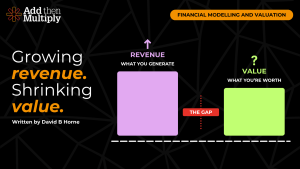
Revenue is NOT the same as growth.
Getting bigger is what happens when the top line climbs. Growth is what happens when the business becomes more valuable, more resilient, and less dependent on the founder being in every room.
Most founder-led businesses between £1m and £10m are getting bigger. Far fewer are genuinely growing.
The reason is almost always the same. The foundations were never built.
- Strategic financial planning: knowing your numbers cold, understanding your unit economics, having a rolling cash forecast that tells you the truth before a problem becomes a crisis. That’s the first foundation.
- Operational excellence: systems and processes that allow the business to deliver consistently, whether you’re in the room or not. That’s the second.
- People and culture: a team strong enough to carry weight when you step back, aligned around values clear enough to survive an acquisition or a period of rapid growth. That’s the third.
- Technology and innovation: tools and infrastructure built for where the business is going, not where it’s been. That’s the fourth.
When all four are in place, the exciting stuff, raising capital, acquiring a competitor, consolidating a market position, planning an exit, all of it becomes possible.
When they’re not, every ambitious move you make is building on sand.
The FACE methodology: a different way to scale
Years ago, I had to make a decision. Chase growth the slow way, or change the rules entirely.
I chose to change the rules. The result was the FACE methodology: Fund, Acquire, Consolidate, Exit.
It’s a structured way to grow a business that doesn’t rely on you working harder. It relies on your business working smarter.
Fund: Securing the right capital to fuel strategic expansion, on the right terms, at the right time.
Acquire: Growing by bringing in complementary businesses rather than fighting for every percentage point of organic growth.
Consolidate: Integrating what you’ve built, tightening operations, unlocking the efficiencies that turn two businesses into one stronger one.
Exit: Positioning the business to achieve maximum value when the time comes, whether that’s in two years or ten.
The founders who move through FACE fastest are never the ones with the biggest ambitions. They’re the ones who did the foundations work first.

Find out where you actually sit in it.
Most founders skip the foundations and wonder why the exciting stuff doesn’t hold. Our Funding-Ready Scorecard shows you exactly where you stand, before a funder, lender, or acquirer does it for you.
⚡ Try it now, it takes less than a minute.
Why your numbers need to tell a better story
I’ve sat across the table from hundreds of investors, lenders, and acquirers over the course of my career. I’ve been on both sides of that table.
Here is what I can tell you with certainty.
The businesses that raise capital on the best terms are not always the most impressive businesses. They are the businesses with the clearest numbers. The ones where the founder walks in knowing their unit economics, their gross margin, their cash runway, their EBITDA, and exactly what the money will do.
The businesses that get passed over are often genuinely strong businesses with genuinely weak financial reporting. They lose not because of what they’ve built but because of how they’re presenting it.
A Financial Deep Dive uncovers exactly where the gaps are. Financial modelling gives you the tools to forecast, test scenarios, and walk into any room with confidence. An insourced CFO gives you the strategic financial leadership of a seasoned finance director, without the full-time cost.
These aren’t luxuries for businesses at this stage. They’re the difference between a conversation that goes somewhere and one that doesn’t.
Ready to close the gap?
In my experience, most founders know something is wrong before they can name what it is. They feel it in the cash position that’s harder to read than it should be. In the reporting that’s always a little late. In the sense that the business is running them, not the other way around.
Ninety days of the right financial support changes that entirely.
A 13-week cash forecast that you actually trust. Month-end reporting delivered on time, decision-ready, and clear enough that you can share it with a lender or board without apology. A strategic plan that tells you where the business is going and what it will take to get there. Founder time freed up, not by doing less, but by having the right team and systems carrying the weight they should have been carrying all along.
That’s what financial foundations actually look like in practice. Not a spreadsheet. Not a compliance exercise. A business that runs better because the numbers finally make sense.
Know your numbers. Build your foundations. Then add. Then multiply.
Before you go
If this week’s blog resonated, you’re probably already asking the right questions.
Here are three places to start.
📖 Add Then Multiply Book: https://resources.addthenmultiply.com/atm-book
The full FACE methodology with real stories and real numbers from founders who’ve scaled.
⚡Our Funding Scorecard: https://areyoufundingready.scoreapp.com
Find out if your business would hold up before a funder, lender, or acquirer asks the questions.
✉️ My weekly newsletter: https://resources.addthenmultiply.com/newsletter-signup
The Multiplier Effect lands every Wednesday. Practical thinking on funding, scaling, and building a business worth owning.
David B Horne

Founder of Add Then Multiply & Funding Focus
Add Then Multiply is a fractional finance and business scaling consultancy helping founder-led businesses at £1M–£10M+ to Fund, Acquire, Consolidate, and Exit.